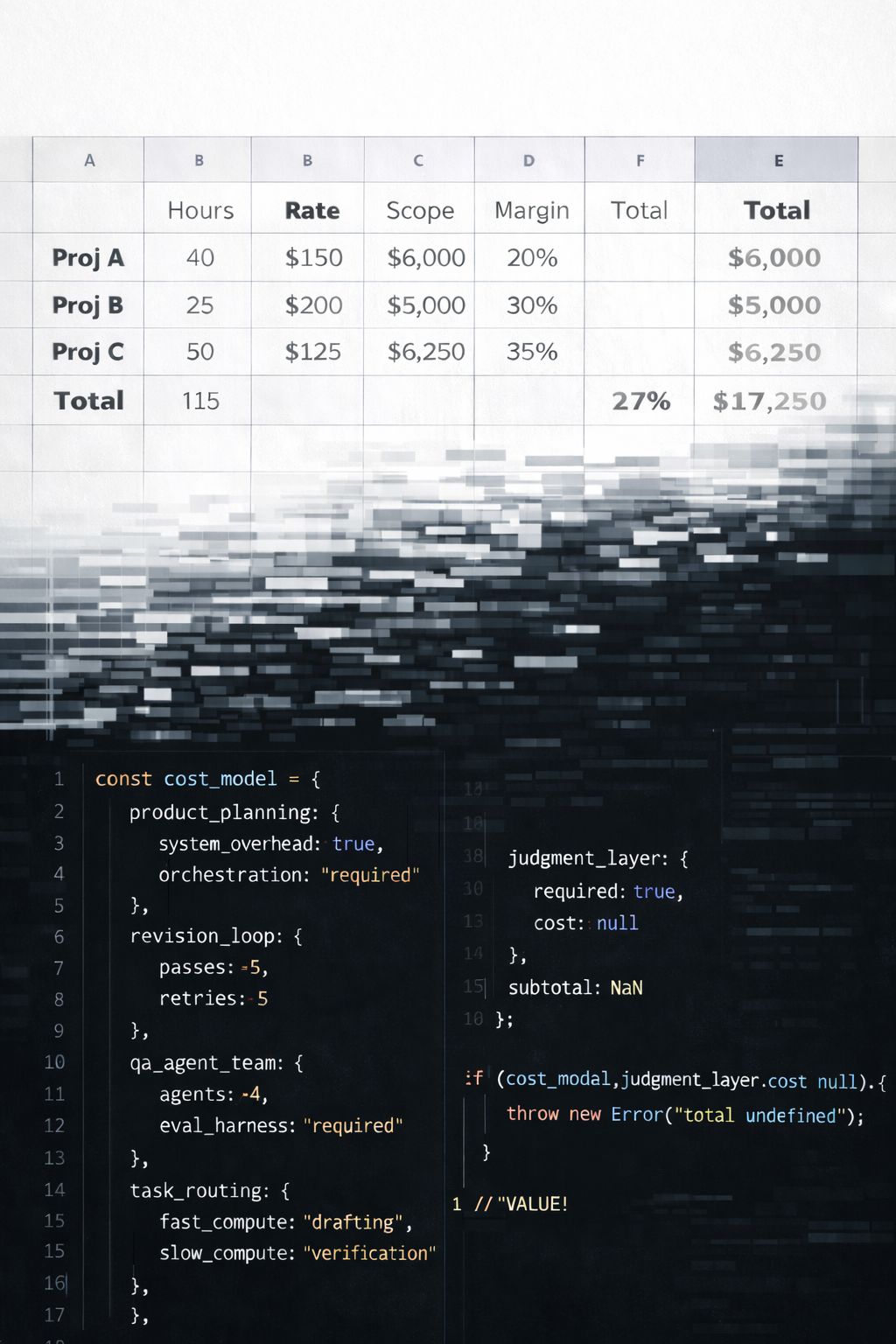

The Unit Economics Broke
How do you know what anything costs now? Building software for founders in 2026.
In 2007 I was at Georgetown when Tim O'Shaughnessy came back to visit my CS class.
On one visit, we built a Chipotle app on Facebook where you could assemble a digital burrito ingredient by ingredient.
At the time, his company was called Hungry Machine.
That name stuck with me for almost 20 years.
Hungry Machine eventually became LivingSocial, Groupon's main competitor, and blew up. The name made sense long before I understood why: the machine was hungry. You had to keep feeding it. Keep iterating. Keep learning.
Today, we all run hungry machines. And that's exactly why it's hard to understand what anything costs anymore.
The stable unit is gone
For a long time, software was easy to explain economically. You paid by the hour, or you paid for a scoped project. Different models, same assumption: there was some stable unit underneath the work.
In 2026, that assumption feels broken.
Because those aren't really the unit anymore.
The real unit is the loop.
Idea, build, feedback, refine. Idea, build, feedback, refine.
That's what product development actually is. Nobody ships once and calls it a day. Founders change their minds. Teams react. Markets react. Customers react. Priorities move.
Last month a founder sent me a 40-page spec and asked what it'd cost. I told him that in three weeks, the spec probably wouldn't matter.
He laughed.
A couple weeks later, a competitor posted something on Twitter and he wanted to throw out half the spec for a new direction.
It happens every time.
That's not dysfunction. That's the process.
The real question
Which means the real question is no longer just "what does this cost?"
It's: what does it cost to run the loop?
AI makes this even more confusing.
Some execution is cheaper now. Some code gets written faster. Some QA gets compressed. Some planning gets lighter. Work that used to take days now takes hours.
But that's not what drives successful outcomes.
Last week John Borthwick called the real thing judgment density. The accumulated deliberate choices per surface of product. Every pixel, interaction, and word is a decision someone made instead of defaulting.
Why old pricing feels fake
That's why old ways of talking about software cost feel fake.
Hourly pricing misses the point because the value isn't a neat stack of visible hours.
Fixed scope misses the point because the scope usually stops being real the second the world changes.
And every time you stop to re-scope, re-quote, re-approve, and re-plan, you're paying a tax.
Not a tax on building.
A tax on iteration.
So what does software cost in 2026?
Less than it used to in raw execution. More than it looks like in judgment. And mostly, whatever it takes to keep the machine fed.
Not the hour. Not the milestone. The loop.